Problem
Enterprise customers lack actionable and reliable insights on what their teams are working on because users hate logging time.
Opportunity: Capacity Insights presented an opportunity for Tempo to expand beyond time tracking into strategic planning by addressing a key customer pain point: understanding team capacity across multiple projects and timeframes. As organizations scaled agile practices, they needed clearer visibility into future availability to plan work more effectively. By introducing AI-driven insights, Tempo could differentiate its product suite, deepen engagement with existing customers, and open new revenue streams in the strategic portfolio management space.
My Role: At Tempo, I led design for Capacity Insights, a 0–1 product that aimed to help teams forecast availability using AI-generated insights. I worked closely with PMs and engineers to define core use cases, translate complex capacity data into actionable visualizations, and explore automation opportunities for agile planning. My role spanned from early discovery through prototyping and usability testing to support an iterative build-measure-learn cycle.
How might we help teams anticipate and plan their future availability more effectively through AI-powered capacity insights, so they can make smarter, faster resourcing decisions?
Objectives 🎯
Overview
Enterprise customers struggle with accurately assessing workload distribution and capacity for their agile teams, leading to inefficiencies and missed deadlines.
Tempo’s AI-powered Timesheets along with Tempo’s Capacity Planner’s capacity planning solution provided enterprise customers with a solution to their struggles with workload distribution and increased the efficiency of logging time in timesheets through AI recommendations/suggestions.
Following the success of these solutions, we talked to customers and forged a path at the intersection of the two solutions, with a focus on agile teams. Capacity Insights aimed to solve the problem of inefficiencies and missed deadlines by providing actionable insights into team capacity.
Strategy
- Disrupting the engineering capacity management market with a net new product in the Atlassian marketplace that leverages AI.
- Providing data-driven actionable insights to managers in the Software development space.
- Increase in enterprise customers by solving for their pain points.
integrations ↔️
Leverage Integrations
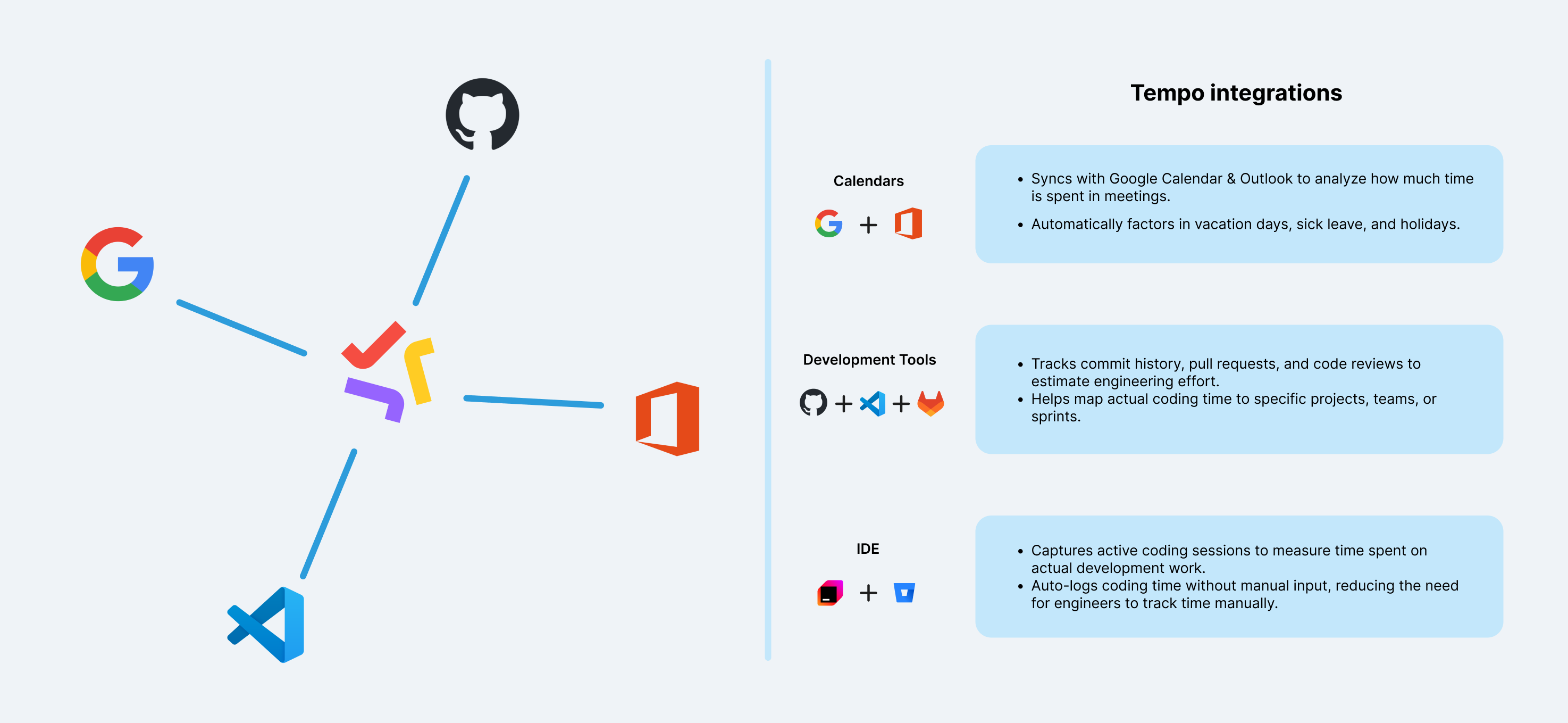
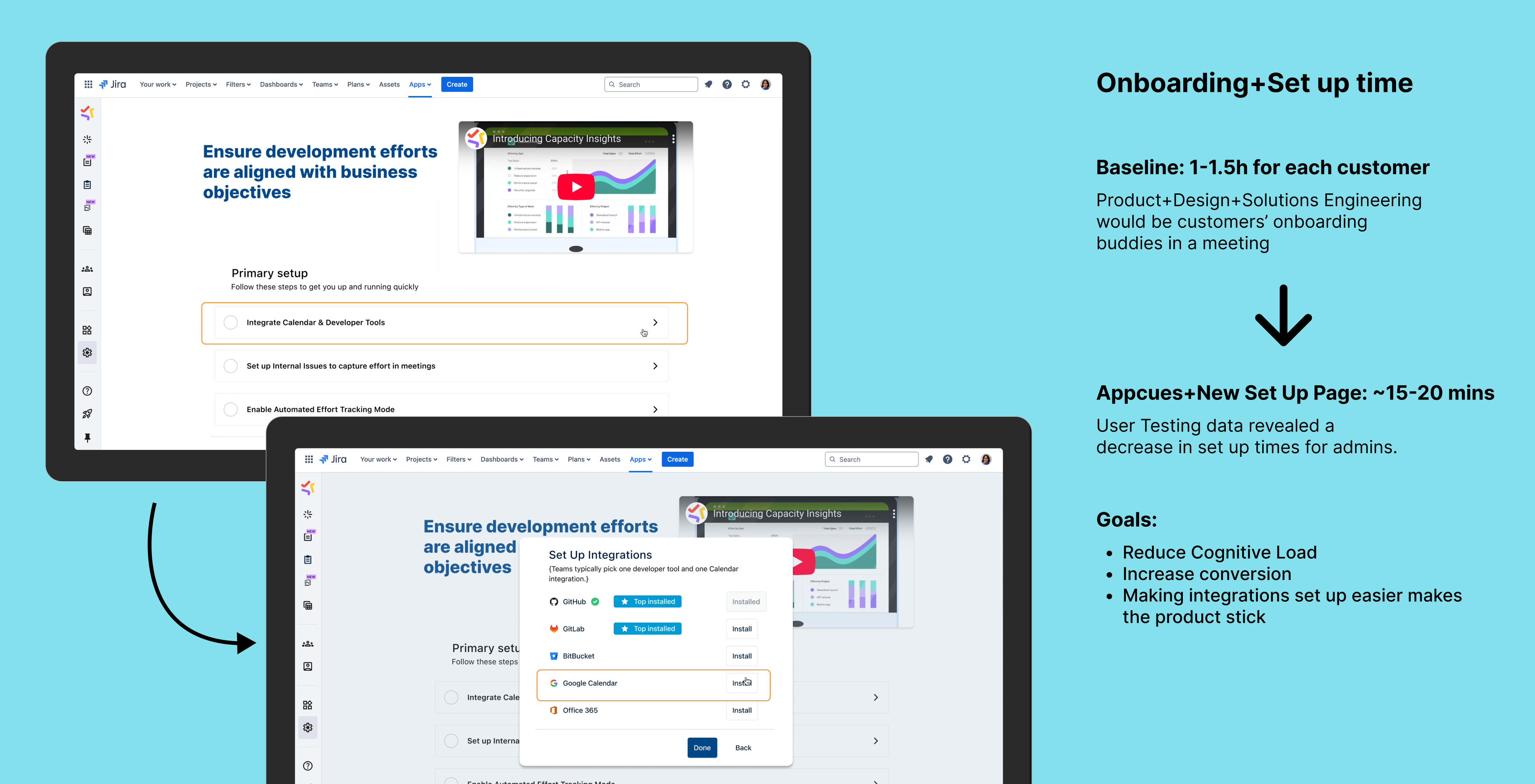
We decided to leverage Timesheets by Tempo’s integrations to help users get a better picture of the work they did thanks to integrations with Google Calendar, Office 3655, Github and VS Code (to name a few).
In order to tackle a major pain point that was identified from enterprise customers, we released organization-level integrations, where an admin can enable integrations for the entire organization or specific Tempo Teams that they choose.
This reduced the burden for individual contributors as they no longer have to manually go in and enable each integration in their instance.
Onboarding Collaboration with growth🙌🏽
Reducing Time to Value (TTV)
I collaborated with the Growth team to build the onboarding flow together and created a strategy for the onboarding process for the product. This included mapping out which part of the flow will use Appcues, which will have in-product touchpoints, etc. It was a very fun learning experience.
iterative design 🔄
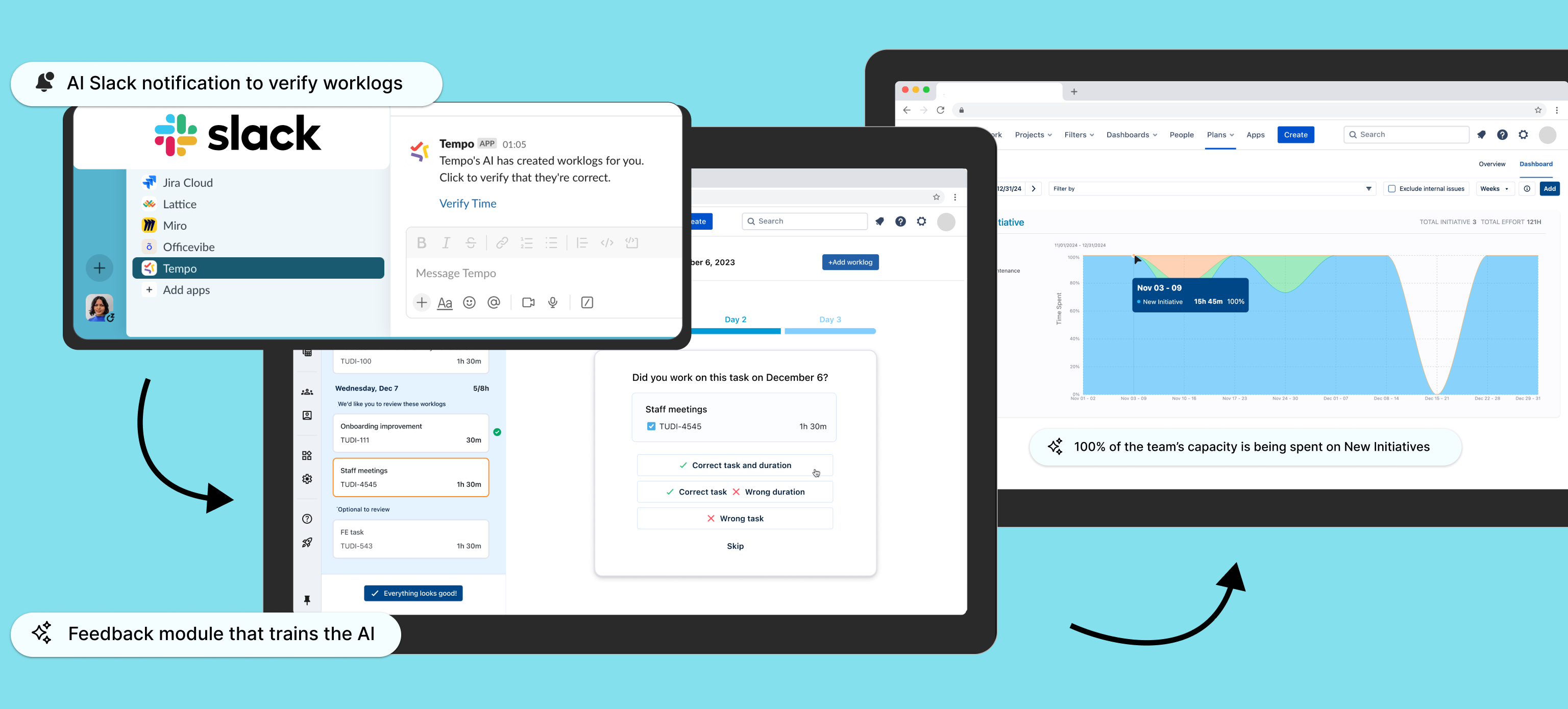
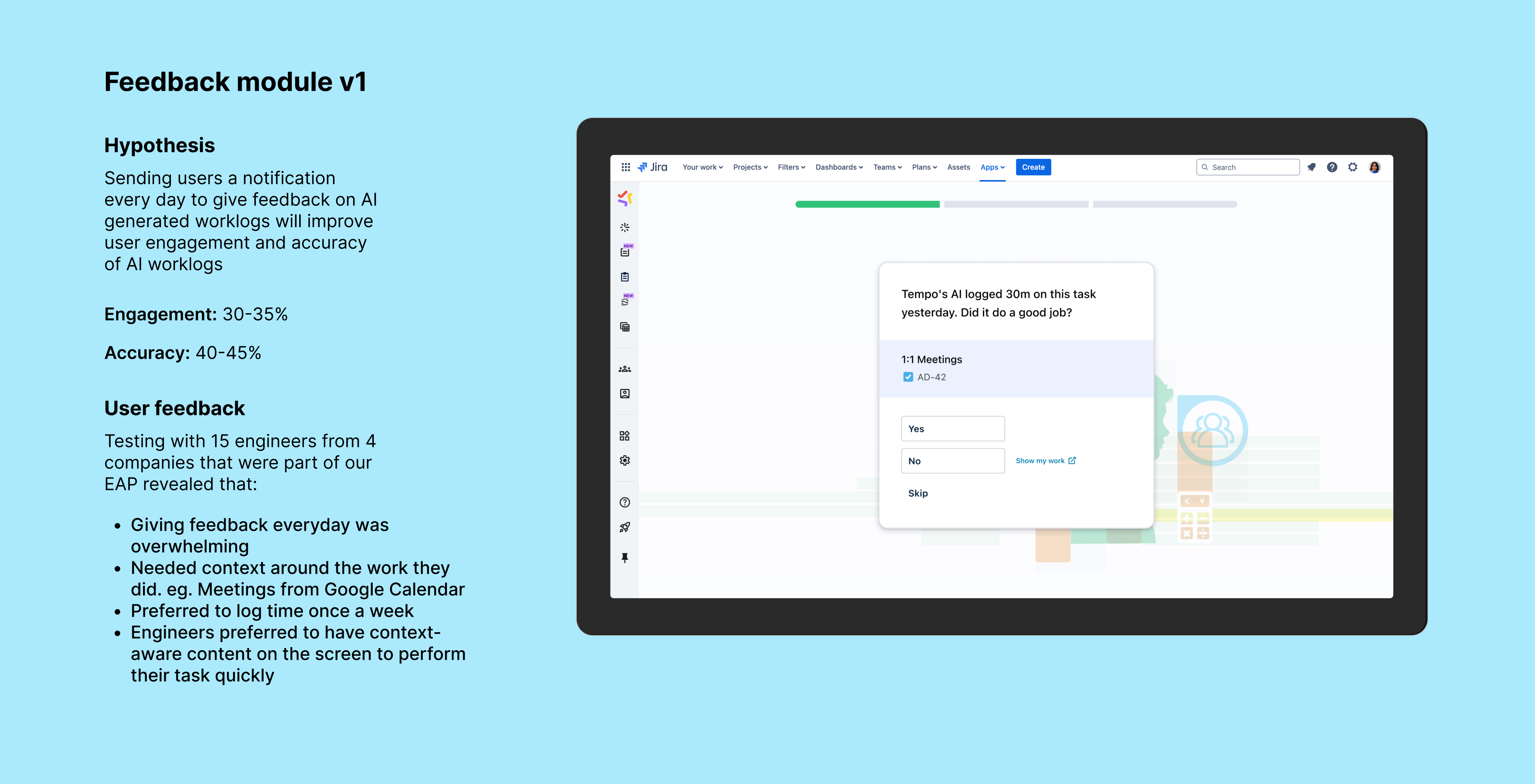
Feedback module to increase AI work entry accuracy
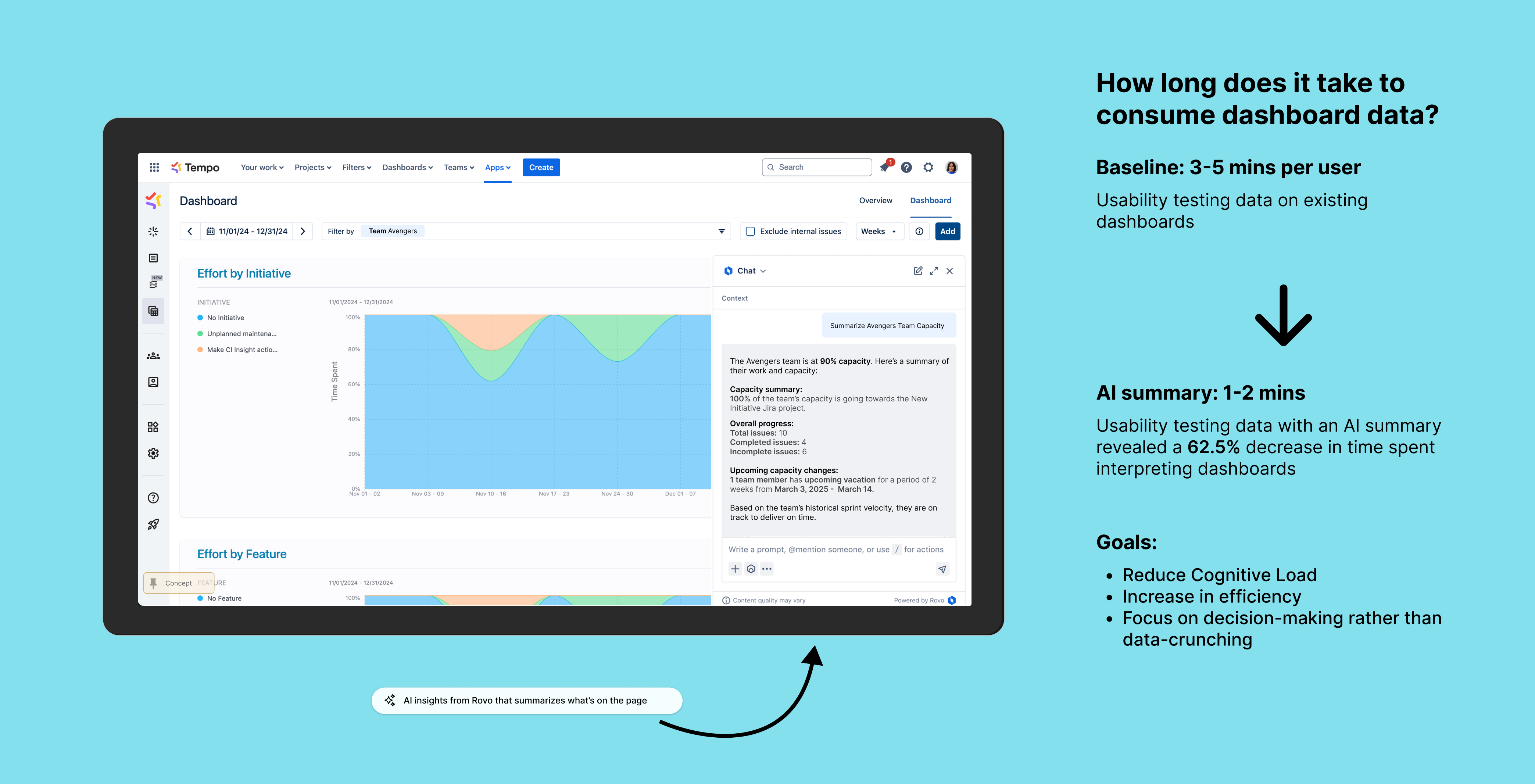
Giving AI summaries of dashboard data is the next step in Capacity Insights’ journey. Atlassian’s introduction of Rovo meant that we had to take into account whether we wanted to leverage Rovo or create our own AI summaries from scratch. This is still up in the air. However, we already have some usability testing data for existing dashboards along with a concept for Rovo integration. Customers are very keen on seeing Rovo in the Tempo suite.

Future 🔮
AI summary using Rovo
Giving AI summaries of dashboard data could be the next step in Capacity Insights’ journey. Atlassian’s introduction of Rovo meant that we had to take into account whether we wanted to leverage Rovo or create our own AI summaries from scratch. This is still up in the air. Customers are very keen on seeing Rovo in the Tempo suite.
Learnings and reflections 💬
Shaping the big picture
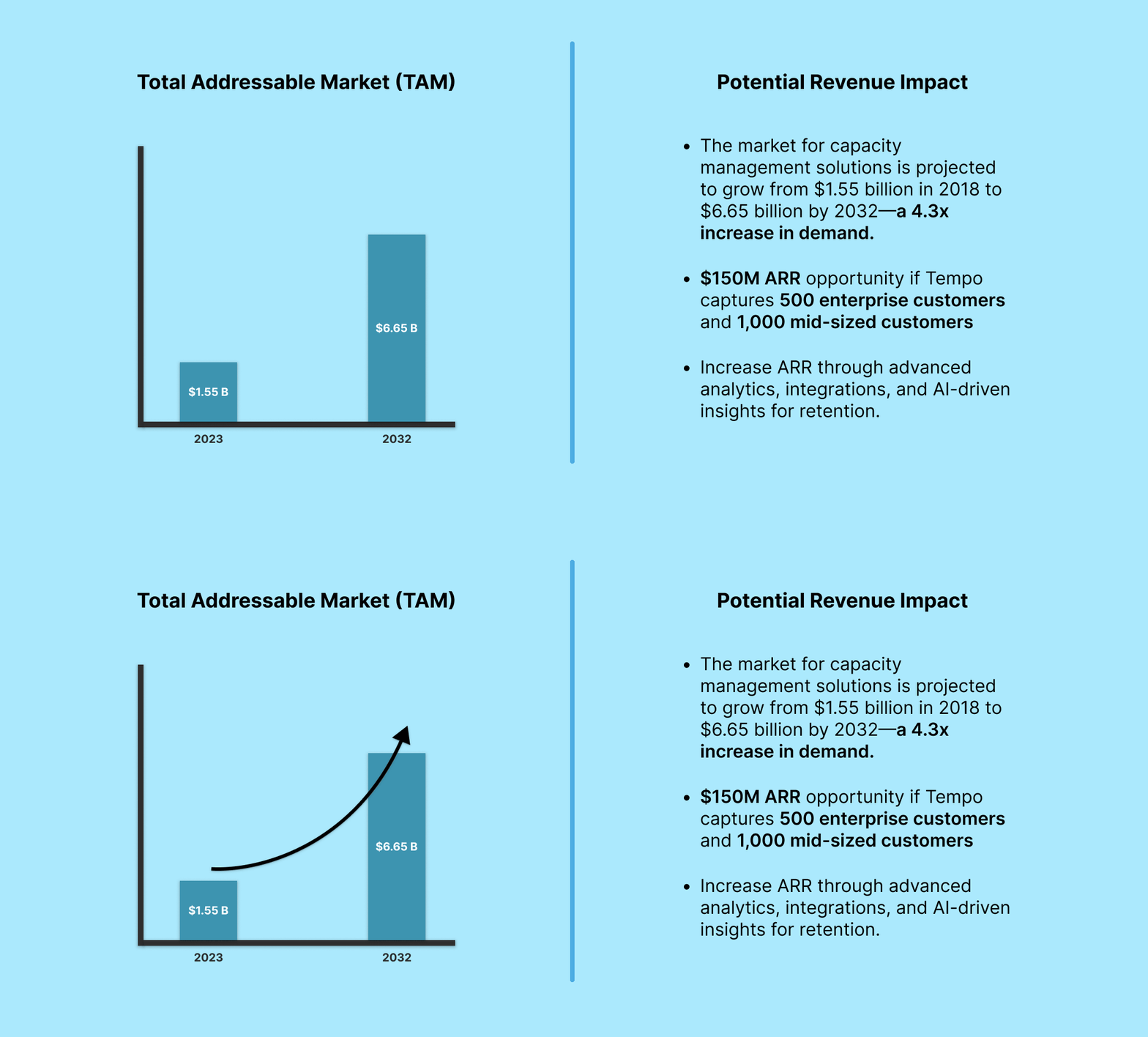
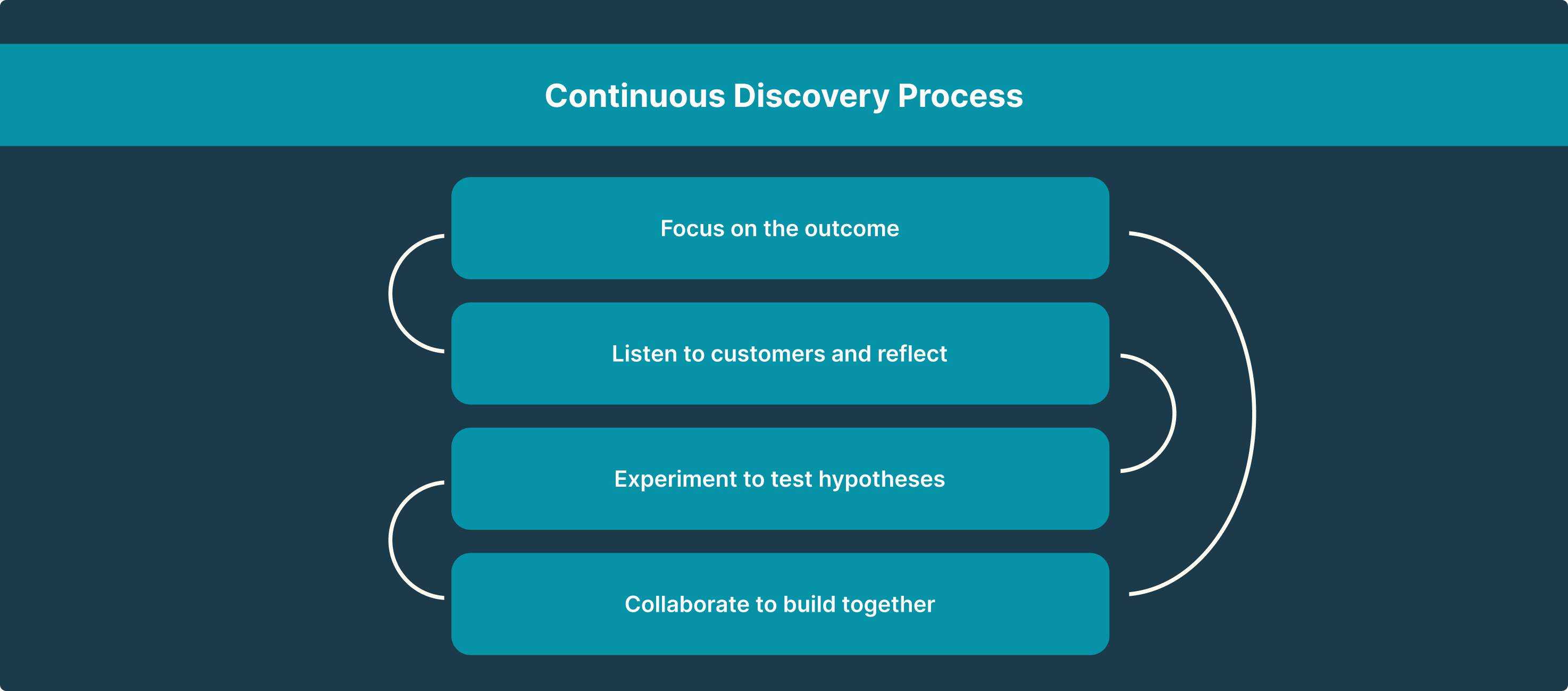
Collaborating with various teams across the organization as well as engaging with stakeholders at the C-Suite level to find product-market fit helped me look at design from a different lens. I studied and learned about a lot of business related things like the difference between Total Addressable Market (TAM), Serviceable Available Market (SAM), and Serviceable Obtainable Market (SOW) as well as how they contributed to calculating Projected Revenue. All of this informed my design strategy and decisions.
 Nicole Merchant